If you’ve been following the AI landscape over the past year, you’ve probably encountered the term ‘agentic AI.’ AI agents that don’t just answer questions, they take actions. They search the web, write code, send emails, update records, and complete complex tasks without a human in the loop for every step.
It sounds compelling. It also sounds like a nightmare to actually build, especially inside the complex system environments that Singapore enterprises run: SAP, Salesforce, Oracle, proprietary databases, government APIs like MyInfo, payment rails like NETS and 2C2P.
That’s where the Model Context Protocol (MCP) comes in. And if you’re a CTO, CDO, or enterprise architect in Singapore, this is one of the most important AI developments of 2026.
The Problem MCP Solves
Here’s the challenge every enterprise faces when deploying AI: your data and systems are everywhere. Your customer records are in Salesforce. Your financials are in SAP or NetSuite. Your HR data is in Workday. Your proprietary knowledge lives in SharePoint, Confluence, or a collection of internal databases that’s grown organically over decades.
When you try to give an AI model access to all of this, you face a fragmentation problem. Every connection has to be custom-built. Every integration is bespoke. Every time the AI needs to pull data from a new source, someone on your team writes more glue code.
It’s the same problem the software world had with data connectors before REST APIs standardised how systems talk to each other. And just as REST solved that problem, MCP is solving it for AI.
What Is MCP, Exactly?
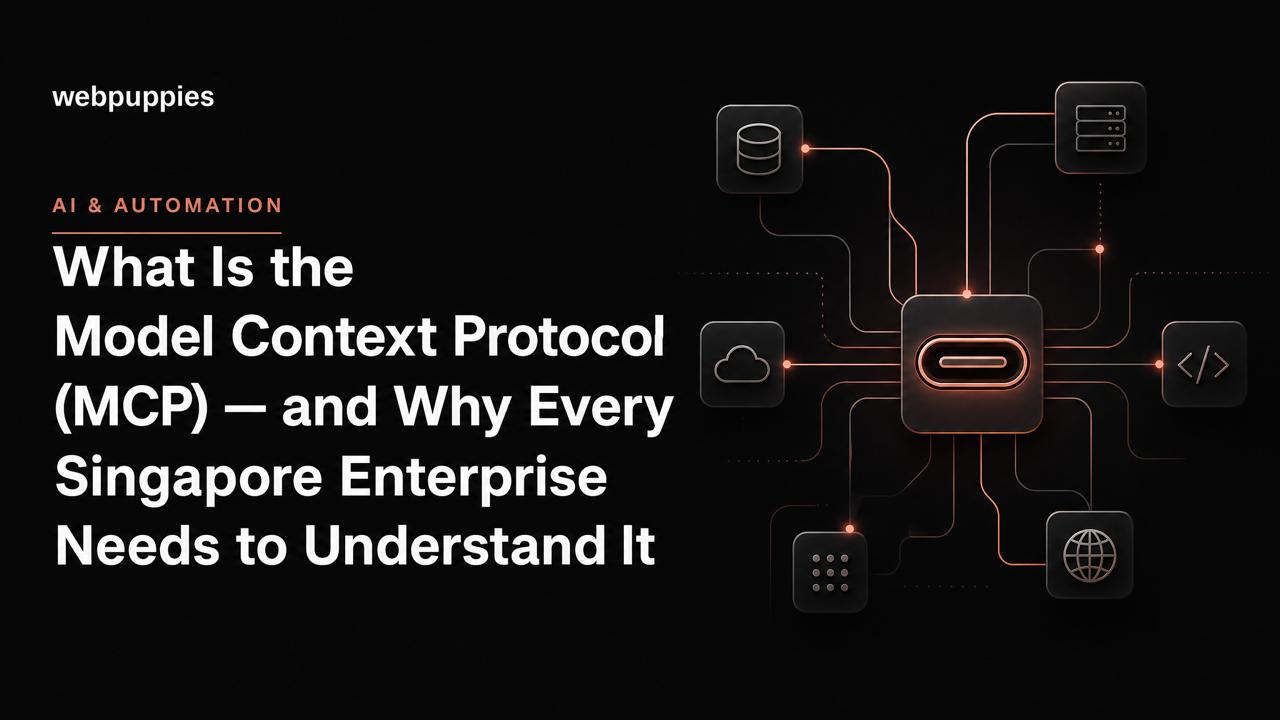
Model Context Protocol is an open standard, developed by Anthropic, that defines how AI models communicate with external data sources and tools. Think of it as the USB-C of AI integration.
Before USB-C, every device had its own connector. You needed different cables for your phone, your laptop, your camera. USB-C created a single standard that everything could plug into. MCP does the same thing for AI: it creates a single, secure communication standard that any AI model can use to connect to any enterprise system — without bespoke integration code for each pair.
In practice, MCP works like this:
- An MCP server sits between Claude and your enterprise systems
- The server exposes specific capabilities — ‘read from this database,’ ‘search this knowledge base,’ ‘update this CRM record’ — as standardised tools
- Claude discovers what tools are available and uses them to complete tasks
- All communication is structured, logged, and permissioned — the AI only accesses what it’s allowed to access
Why This Changes Everything for Enterprise AI
Before MCP, building a Claude-powered AI system that could genuinely interact with your enterprise environment meant building custom connectors for every system. That’s expensive, fragile, and hard to maintain. It’s also why most enterprise AI projects start as demos and never make it to production.
With MCP, the picture changes dramatically:
Faster time to value
Pre-built MCP servers already exist for many popular enterprise platforms — Salesforce, GitHub, Slack, Google Drive, and others. Instead of weeks of integration work, connecting Claude to your CRM is a configuration task, not a development project.
Security and governance by design
Because MCP defines permissions at the server level, you can specify exactly what the AI can and can’t do. Claude can be given read access to customer records without write access. It can search the knowledge base without accessing financial data. Governance is built into the architecture, not bolted on afterward.
Composable AI systems
With MCP, you can build AI agents that combine multiple data sources in a single workflow. A customer service AI might check the CRM, query the inventory system, review the order management database, and draft a response — all in one task, using standardised connections to each system.
Real-World Use Cases for Singapore Enterprises
Here’s what MCP-enabled Claude deployments actually look like in practice — and these are applications directly relevant to the sectors we serve across Singapore and APAC.
Financial services
A Claude agent with MCP connections to a bank’s CRM, core banking system, and regulatory database can automate loan application review — pulling customer history, cross-referencing credit data, checking regulatory requirements, and generating a structured assessment for a human loan officer. What took hours now takes minutes.
Healthcare and pharmaceuticals
A Claude agent connected via MCP to a hospital’s patient management system, clinical database, and drug reference library can assist clinical staff with patient summaries, flag potential drug interactions, and retrieve relevant treatment guidelines — securely, with full audit trails, and without exposing sensitive patient data beyond the permissioned scope.
Government and statutory boards
MCP enables Claude to interface with MyInfo APIs, grants databases, and citizen service platforms in a structured way. Intelligent citizen-facing services can now access live data, personalise responses based on verified identity attributes, and escalate complex cases to human agents — all within the data governance framework that government deployments require.
Retail and e-commerce
Claude agents connected via MCP to inventory, CRM, and pricing systems can handle complex customer enquiries about stock availability, loyalty points, order status, and product recommendations in a single, coherent conversation — without the customer having to be transferred between departments or systems.
How Webpuppies Is Implementing MCP
As a certified Anthropic Claude Partner, our team is trained in MCP architecture and implementation. We’ve built MCP-integrated systems across several client environments, connecting Claude to enterprise platforms including Salesforce, SAP, and proprietary internal databases.
Our approach follows a three-phase framework:
- Discovery — mapping your existing systems, data flows, and governance requirements to identify the right MCP integration points
- Architecture — designing the MCP server structure, permission model, and Claude agent workflow for your specific use case
- Build and govern — implementing the integration with full audit logging, access controls, and a monitoring layer that gives your IT and compliance teams visibility over what the AI is doing
We don’t treat MCP as a shortcut. We treat it as the foundation of a responsible, scalable enterprise AI system — one that your organisation can trust in production, not just in a proof-of-concept.
“MCP is the missing piece that makes enterprise AI actually work. Not the AI itself—but the secure, structured bridge between the AI and the systems your business runs on every day.”
→ Ready to explore MCP for your enterprise? Talk to our certified Claude AI team at webpuppies.com.sg